

AI opportunities in the Providence College School of Business
Artificial intelligence is reshaping the business world and business education. The Providence College School of Business provides a number of opportunities for students to gain AI expertise, both inside and outside the classroom. Here are some examples:
A group of students from the Providence College School of Business is working on a zero-waste agricultural project on the other side of the globe, thanks to the power of technology. Rev. Godfrey Nzamujo, O.P., a Dominican friar from Nigeria, started the initiative. Nzamujo, who holds a number of advanced degrees, including a doctorate in microbiology, founded the Songhai Center in Benin in 1985, and since then it has become a center for sustainable agriculture: the achievements include regenerating land so it’s arable for crops, recirculating water, and providing people with both jobs and food. Father Nzamujo has expanded this initiative across West Africa, met with leaders at the United Nations, and even earned a Mastercard grant for continued work.
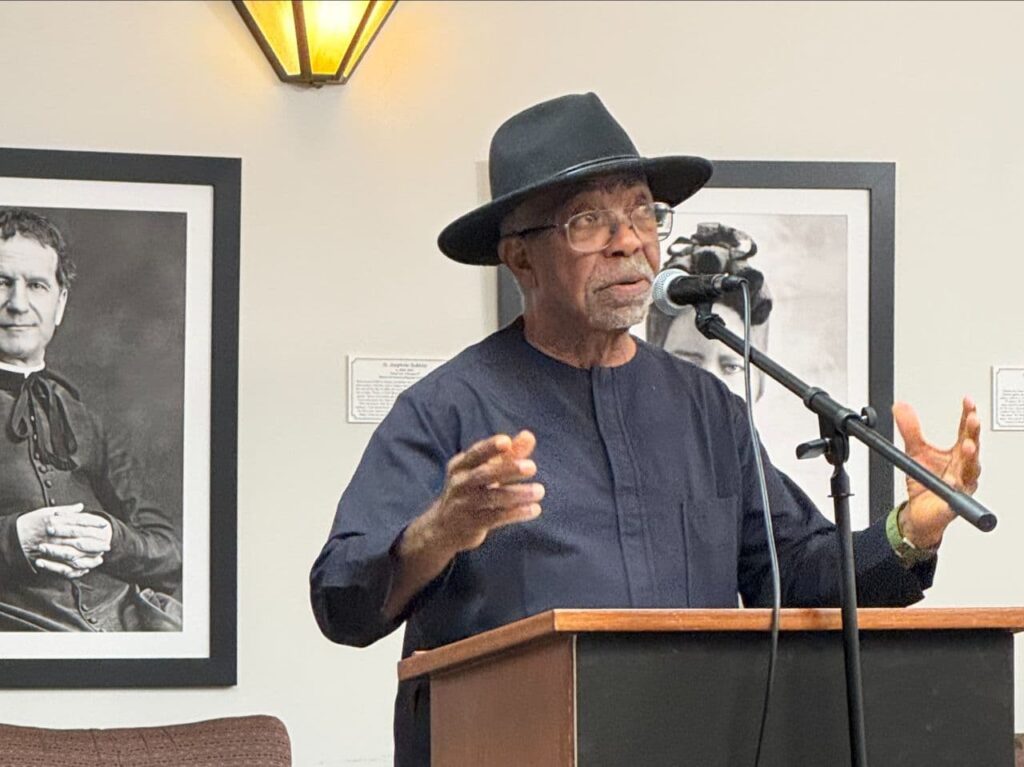
How are students using AI for the Songhai Center?
The students are enrolled in a class with Marianne Doran-Collins, MBA ’85, the business school’s director of data analytics and AI. The goal of the course, Embrace AI Strategy, is to assist Father Nzamujo in developing his AI strategy. They look to identify use cases, or where he should implement AI, and the requirements for doing so. Now that this project is underway, how should Songhai’s leaders communicate with the 40,000+ individuals and entrepreneurs that want to grow this initiative? How do they raise awareness and excitement among people in West Africa? These are all questions that the students hope to answer using artificial intelligence technology, all while maintaining the human connection that makes this project so special.
What is the PC Business attitude toward AI?
This project represents of the PC Business’s approach to using AI — as a tool that when, used ethically, can contribute to the human good. Because of the broad scope of how it can be applied, there is no school-wide policy on its use. The approach will vary depending on course and professor. However, guidelines are being developed to aim students toward using AI in an ethical, assistive way. Doran-Collins explained the “Four V’s” of AI usage: verifying, vetting, visibility, and validating.
While guidelines will be helpful for students and faculty to reference, some professors are taking their own initiative in implementing AI, conducting research, and employing different methods in their own classroom already. Jonathan Jackson, Ph.D., associate professor of finance, shared his practical approach for incorporating AI into classroom activities for his Operations Management course.

How are students using AI in Operations Management?
The plan started with goals for students: getting them engaged and working in groups, teaching them to prompt and be strategic, and overall to give them practice in using AI. Rather than lecture on these topics, Jackson wanted to take a more active learning approach to make his students engaged participants. So, he categorized AI activities into four groups. First, how can we apply concepts to new industries? Although Jackson teaches Operations Management, he wants the students to translate the concepts across industries and academic fields. Next, AI activities can fall into the category of assessing and improving AI explanations: students take a higher-level concept, ask AI to explain it, and see if it matches what they’ve learned in class. Additionally, students practice identifying appropriate tools and approaches in real-world scenarios. Finally, Jackson has his students construct debate arguments using AI.

Throughout these in-class activities, he emphasizes the importance of getting multiple answers from whatever engine you’re working with and comparing responses from different AI assistants. He stressed that the way you prompt also determines the quality of the answer you’re getting. It’s important to follow the RCTF model: role, context, task, and format.
The responses of business students to these activities can be used to shape AI pedagogy moving forward. In particular, Friars reported that this style of learning proved to be engaging, relevant, allowed for collaboration, and representative of real-world scenarios. For Jackson, he believes this last achievement is the most important in his class: because it is a core class that everyone is required to take, he hopes they leave with lessons they can actually use in the future.
How else can students learn about using AI?
Outside of Operations Management, the business school has offered other chances to learn more about AI. The business school offers an AI certification program and has hosted ethics debates or data analytics showcases. In October, students attended a presentation with Stella, a robotic dog by Stellix, an industrial engineering company, learning about the power of AI in data, marketing, and management.
More and more teachers are adopting their own models for AI approaches, but one thing remains constant — PC Business sees artificial intelligence as a tool to achieve human good. The school’s mission is to provide an ethics-based education, and in that way, AI must be used ethically.